Showing posts with label Buddha. Show all posts

11/02/2014

my Buddha life


getting older -
half of my Buddha
still in the light


:::::::::::::::::::::::::::::::::::::::::::::::::::::::::::::::::::::::::::::::::::::::::::::::::::::

. . . Read my Haiku Archives . . .

:::::::::::::::::::::::::::::::::::::::::::::::::::::::::::::::::::::::::::::::::::::::::::::::::::

12/24/2013

forget it all

:::::::::::::::::::::::::::::::::::::::::::::::::::::::::::::::::::::::::::::::::::::::::::::::::::::


Christmas time !


source : facebook


:::::::::::::::::::::::::::::::::::::::::::::::::::::::::::::::::::::::::::::::::::::::::::::::::::::

. . . Read my Haiku Archives . . .

:::::::::::::::::::::::::::::::::::::::::::::::::::::::::::::::::::::::::::::::::::::::::::::::::::

8/14/2013

cool Jizo


great summer heat -
my little friend prays
for coolness


The heat wave this year in Japan is severe and prolonged.


. Jizoo Bosatsu (Kshitigarbha) 地蔵菩薩 Jizo .


photo source : butuzou-world.com

:::::::::::::::::::::::::::::::::::::::::::::::::::::::::::::::::::::::::::::::::::::::::::::::::::::

. . . Read my Haiku Archives . . .

:::::::::::::::::::::::::::::::::::::::::::::::::::::::::::::::::::::::::::::::::::::::::::::::::::

3/20/2013

Buddha after Rain

:::::::::::::::::::::::::::::::::::::::::::::::::::::::::::::::::::::::::::::::::::::::::::::::::::::


after the rain -
the hollow eyes
of Buddha


:::::::::::::::::::::::::::::::::::::::::::::::::::::::::::::::::::::::::::::::::::::::::::::::::::::


Even w/out rain, vertebrates coming thru the throat?
The picture shows someone trying to starve himself (if i recall right, a woman had to be magically turned to a man to become a buddha at death) into a Miira, or mummy.
What is the story?
Who painted the white below the eyes?
But, wow, hunger can do that (so can neurolgia -- sp? -- or at least i FELT the caverns in and around my eyes before i managed to repair my hurt neck)! As it makes us feel skull-like, we can find a hollowness that, oddly enuf, reflects the content of the Buddha's huge belly: nothing!
Too many words? Perhaps.

- a friend on FB -


:::::::::::::::::::::::::::::::::::::::::::::::::::::::::::::::::::::::::::::::::::::::::::::::::::::


. The Stone Buddha in my Garden .  


. . . Read my Haiku Archives . . .

:::::::::::::::::::::::::::::::::::::::::::::::::::::::::::::::::::::::::::::::::::::::::::::::::::

6/25/2012

Buddha and lavender


rainy night -
the smell of lavender
and fireflies


.................................................................................


coming closer -
the silent prayer
of lavender


weather forecast just announced another
four weeks of the rainy season to go . . .


Look at more

. My Garden Flowers in June .


. My Buddha and Lavender - June 2009 .


. More of my haiku about Stone Buddhas .


:::::::::::::::::::::::::::::::::::::::::::::::::::::::::::::::::::::::::::::::::::::::::::::::::::::

. WKD : rabendaa ラベンダー lavender .


. . . Read my Haiku Archives . . .

:::::::::::::::::::::::::::::::::::::::::::::::::::::::::::::::::::::::::::::::::::::::::::::::::::

12/31/2006

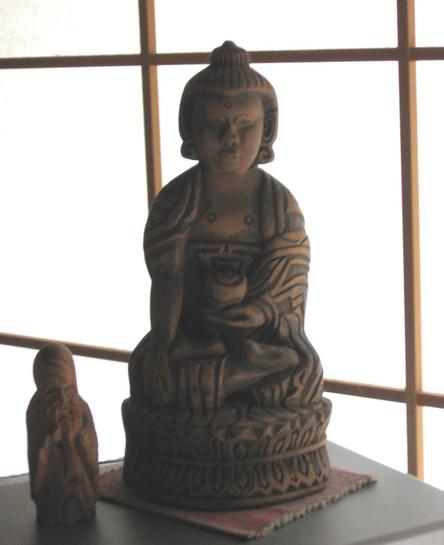
Tibetan Buddha


mild winter sun -
the Medicine Buddha
watches over me


when I caress you
I feel the hands of
your creator


We bought him more than 30 years ago in the Himalayas. He is rather roughly carved. He sits on our TV and takes care of the welfare of our home ! In his hands he holds the never-empty medicine bottle.


Read my Entry about the Tibetan Buddha of Healing

Read my Entry about Yakushi Nyorai, the Buddha of Healing 薬師如来


Read my Haiku Archives from December 2006

***************************

Please send me your contributions

To the Daruma Museum Index

To the World Kigo Database

10/26/2006

Stone Buddha Momiji

:::::::::::::::::::::::::::::::::::::::::::::::::::::::::::::::::::::::::::::::::::::::::::::::::::::


野仏に 紅葉の降るる 山暮らし


red maple leaves
falling on the stone Buddha -
my mountain life


:::::::::::::::::::::::::::::::::::::::::::::::::::::::::::::::::::::::::::::::::::::::::::::::::::::


Nobotoke, Stone Buddha Statues in the fields, imbued with prayers for a good harvest, to pacify the Gods of the Elements.
A lot of them represent Jizo Bosatsu.

We find modern versions also at a roadside place where a deadly accident has taken place, to pray for the rest of the souls lost here.

Along the old pilgrims paths of Japan, many of the stone Buddhas mark the graves of unknown pilgrims (muenbotoke 無縁仏) .


World Kigo Database: Autumn leaves (momiji)


More of my haiku about Stone Buddhas

Doosojin, the Wayside Gods


Read my Haiku Archives from October 2006

***************************

Please send me your contributions

To the Daruma Museum Index

To the World Kigo Database

9/06/2006

Prayer of the Rain


雨の音 屋根が教える 南無阿弥陀


sound of rain -
my roof teaches me
the Amida Prayer


ooo ooo ooo ooo ooo ooo ooo ooo ooo


雨の音 おどる達磨の 足音じゃ


sound of the rain -
Daruma is dancing
on my roof


In a dream last night, the pounding sound of the rain on my large roof started transforming into "Namu Amida Butsu", the prayer to Amida, as if he was teachting me himself to be fearless in stormy weather.
Imagine each rain drop a little Daruma dancing on the roof !
Now I am ready to live through another day of great storm ...


The Story of Daruma Dancing だるま夜話


Amida Nyorai and the Amida Prayer:
Namu Amida Butsu
南無阿弥陀仏


My large roof ...

:::::::::::::::::::::::::::::::::::::::::::::::::::::::::::::::::::::::::::::::::::::::::::::::::::::

Dear Gabi,

If you ever publish a book of your haiku, please reserve a copy for me!

It seems I have come across haiku in which things like streams, and animals such as doves, have also chanted the nembutsu.

There is one in particular by Buson, but before that, read the explanation of the Ceremony:

"Juuya" 十夜法要 is a special ceremony for 10 days of the Amida sects of the Pure Land (Jodo), from October 5 to 10 of the old lunar calendar.
O-Juya means "ten nights.” In the Sutra of The Infinite Life, it says: “If good is practiced in the secular world for ten days and nights, it is superior to the practice of good in the Buddha’s land for one thousand years. The reason is that there are few who do bad in the Buddha’s Land. The blessings and virtues are natural and there is no creation of bad in Buddha’s land. Only this world has wickedness and the blessings and virtues are not natural.”

Because of this verse in the sutra, the O-Juya service confirms our commitment not to do any thing bad and to do every good.


あなたうと茶もだぶだぶと十夜哉
あなたふと茶もだぶだぶと十夜哉 
anata futo cha mo dabu-dabu to juuya kana

Ah, the blessed sound!
The tea also says, "Da-bu, da-bu!"
The ten nights.

tr. Blyth

The season's holy chant
from the teapot too, "dabu, dabu"--
for ten nights.


tr. Sawa and Shiffert


And one I found by Ryoota:

shirayuki no naka ni koe ari kan nembutsu

Within the clouds
There are voices:
Winter nembutsu.


tr. Blyth

So you are in good company!

Larry


Thanks so much, Larry.
In this case here is another of our Amida experiences you might enjoy

and click HERE to look at this voice !


:::::::::::::::::::::::::::::::::::::::::::::::::::::::::::::::::::::::::::::::::::::::::::::::::::::

. World Kigo Database .

***************************

Please send me your contributions

To the Daruma Museum Index

To the World Kigo Database

1/21/2006

Tokei-Ji


the welcome path
leading to another world -
snow, snow, snow


snow in the temple
the Buddha smiles
in silence


graves in the snow -
to wait for nothing
to want for nothing


:::::::::::::::::::::::::::::::::::::::::::::::::::::::::::::::::::::::::::::::::::::::::::::::::::::


Thank you, Mark!
The photos are a curtesy of Mark Schumacher, who visited the temple in January 21, 2006.
Mark Schumacher: All about Buddha Statues


It was one of my favorites when I lived in Kamakura and I visited it very often during all seasons in Kita-Kamakura.
The graveyard in the slopes is very fascinating.


- quote -
Tokeiji is a small branch temple of the Engakuji school within the Rinzai sect of Zen Buddhism. Its head temple, the Engakuji Temple, stands just a few hundred meters away on the opposite side of the railway tracks.

Tokeiji was founded by the wife of the regent Hojo Tokimune in 1285 after Tokimune had died at a young age. Until the end of the Edo Period, the temple served as a shelter for women who suffered abuse by their husbands and sought a divorce.
An official divorce could be attained by staying at the temple for three years.
- source : japan-guide.com -


Reference : Tokeiji


:::::::::::::::::::::::::::::::::::::::::::::::::::::::::::::::::::::::::::::::::::::::::::::::::::::::::::::::::::::::::::


Here is a special treat for the Haiku Friends

James W. Hackett at Tokeiji. September 11, 2002
The grave of R. H. Blyth is also to be found at Tokei-Ji.
Tokei-ji and Dr. Blyth

北鎌倉 東慶寺 2006年1月22日

Tokei-ji Photos


:::::::::::::::::::::::::::::::::::::::::::::::::::::::::::::::::::::::::::::::::::::::::::::::::::::


. kekkon 結婚 konrei 婚礼 marriage in Edo
and divorce - engiri .


Amulets to
. Enkiri, engiri 縁切り to cut a bond .  


To the Daruma Museum Index
To the Worldkigo Database
- #tokeiji #tokeijikamakura -
:::::::::::::::::::::::::::::::::::::::::::::::::::::::::::::::::::::::::::::::::::::::::::::::::::::

8/19/2005

Frog Adventures


eye to eye
with the stone Buddha -
the small green frog


Auge in Auge
mit dem Stein-Buddha -
der kleine Frosch


This time Karl, our tiny Frog Friend, had really out-done himself
in finding a place for his daily nap.


:::::::::::::::::::::::::::::::::::::::::::::::::::::::::::::::::::::::::::::::::::::::::::::::::::::


More about my Stone Buddhas

Stone Buddhas .. 石仏
... Amida Buddha      
... Arhats in Stone 五百羅漢
... Buddha's Footprints (Bussokuseki)     
... Buddha's Voice (Shakyamuni and the FROG)
... Azalea and Shaka (Shakyamuni)
... Lavender leans on Buddha
... Horseheaded Kannon

Snow in Buddha's hands, December 2008

Buddha and Lavender - June 2012


Karl the Froggie and the Calla   .. 蛙とカラー

Buddha's hollow eyes, March 2013


© Gabi Greve, August 2005


:::::::::::::::::::::::::::::::::::::::::::::::::::::::::::::::::::::::::::::::::::::::::::::::::::::

To the Daruma Museum Index
http://darumasan.blogspot.com/

To the Worldkigo Database
http://worldkigodatabase.blogspot.com/

:::::::::::::::::::::::::::::::::::::::::::::::::::::::::::::::::::::::::::::::::::::::::::::::::::::

6/18/2005

Buddha's Voice


We were sitting on the terrasse,
enjoying some evening breeze,
looking over the quiet valley.

Suddenly the stone Buddha next to the flower bed
started chanting sutras:


whaa, whaa, Amida
whaa, whaa, Amida


We listened to the enchanted sound for a while,
then reality took over.

On a closer look, there was
the originator of the voice:

Look again at the picture above to find him,
before you scroll down !


One of our tiny friends, Karl the Frog,
had taken seat on the Buddha's halo

and chanted his nightly song!


But he did not like the flash of attraction and stopped his song,
as you can see,

his throat is all flat now.

little green frog -
even your voice
the voice of Buddha


ishibotoke
sono koe ni naru
kaeru kana

石仏 - その声になる蛙かな


June 2005
:::::::::::::::::::::::::::::::::::::::::::::::::::::::::::::::::::::::::::::::::::::::::::::::::::::


I have written about the Frog and Buddha before:

Voice of Buddha and Frog


Prayer of the Rain .. Namu Amida Butsu


Amida Nyorai and the Amida Prayer:
Namu Amida Butsu
南無阿弥陀仏


. Buddha Shaka in my Garden .  


.......................................................................................................

Frog (kawazu, kaeru)
a kigo for haiku


:::::::::::::::::::::::::::::::::::::::::::::::::::::::::::::::::::::::::::::::::::::::::::::::::::::

6/11/2005

Taking Shelter


taking shelter
in the Buddha's light -
a dove in the morning


Zuflucht suchen
in Buddha's Licht -
eine Taube am Morgen


灯篭の灯りに隠れし鳩一羽


My SHIKOKU HENRO pilgrimage ARCHIVES


:::::::::::::::::::::::::::::::::::::::::::::::::::::::::::::::::::::::::::::::::::::::::::::::::::::


typhoon -
in the folds of my robe
a bee hiding


Typhoon is a kigo for mid-autumn.

:::::::::::::::::::::::::::::::::::::::::::::::::::::::::::::::::::::::::::::::::::::::::::::::::::::


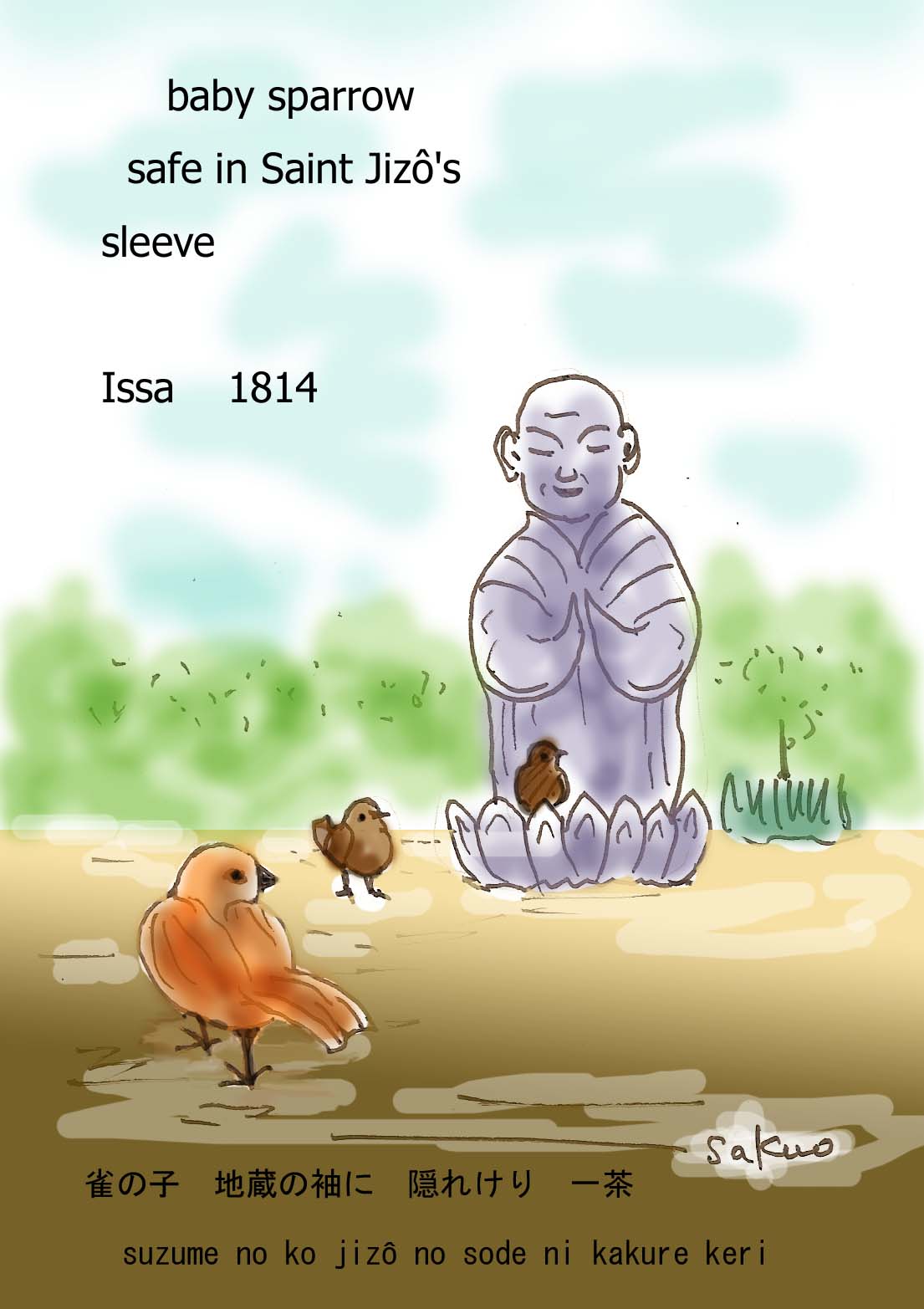
.. .. .. Issa writes about this subject of taking refuge in the Buddha too.


baby sparrow
safe in Saint Jizo's
sleeve


I wrote an explanation about the sheltering sleeve of Jizoo Bosatsu .


..........................................

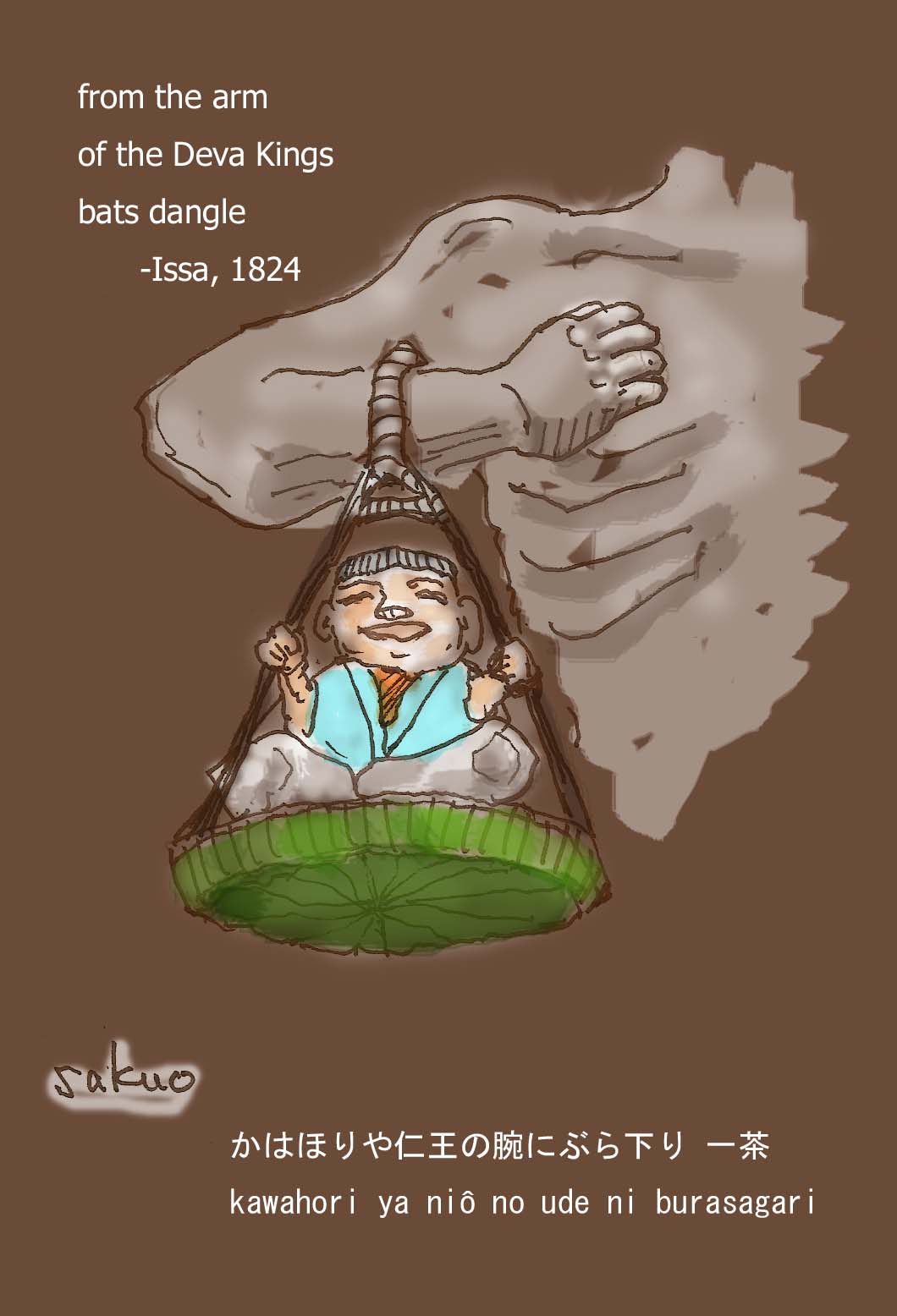
kawahori ya Nioo no ude ni burasagari


from the arm
of the Deva King
bats dangle


.........................................


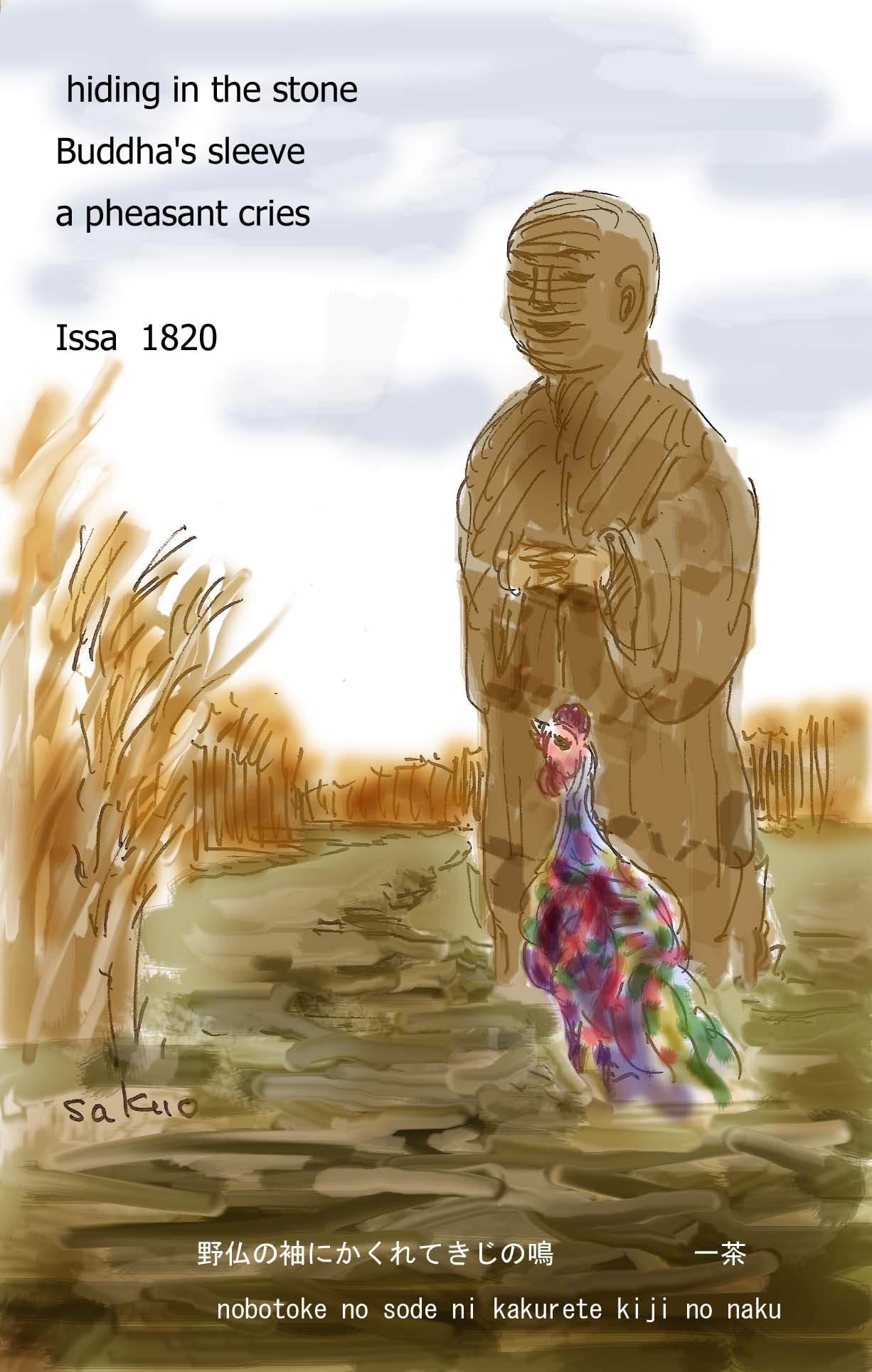
no-botoke no sode ni kakurete kiji no naku


hiding in the stone
Buddha's sleeve
a pheasant cries


Haiga by Sakuo Nakamura

Translations by David Lanoue

:::::::::::::::::::::::::::::::::::::::::::::::::::::::::::::::::::::::::::::::::::::::::::::::::::::


The picture of the dove is from our own haiku pilgrimage to
Shikoku Summer 2005 .

My Stone Buddhas and Haiku

.......................................................

Read about the Buddhas mentioned, by Mark Schuhmacher:

Jizo Bosatsu

Nio Protectors

Stone Lanterns

::::::::::::::::::::::::::::::::::::::::::::::::::::::::::::::::::::::::::::::::::::::::::::::::::::: 

[ . BACK to DARUMA MUSEUM TOP . ]
[ . BACK to WORLDKIGO . TOP . ]

:::::::::::::::::::::::::::::::::::::::::::::::::::::::::::::::::::::::::::::::::::::::::::::::::::::

6/07/2005

Amida Buddha

. Amida Nyorai Legends 阿弥陀如来と伝説 .


Amida Buddha -
you smile at life
you smile at death


Amida Buddha -
you smile at a friend
who took her own life

(at age 20)


Amida Buddha -
you smile at a mother
who left too early

(at age 53, cancer)


Amida Buddha -
you smile at me
I smile at you


Amida Buddha comes down
from the Paradise in the West
to welcome the souls of the dead and
take them back to his heaven.


Read Mark Schumacher with the details of
Amida Nyorai 阿弥陀如来

. Introducing Japanese Buddha Statues .

:::::::::::::::::::::::::::::::::::::::::::::::::::::::::::::::::::::::::::::::::::::::::::::::::::::

kigo for mid-spring

CLICK for more photos

roku Amida moode 六阿弥陀詣 (ろくあみだもうで)
visiting six temples with Amida statues

..... roku Amida mairi 六阿弥陀参(ろくあみだまいり) Rokuamida
..... roku Amida 六阿弥陀(ろくあみだ)
It was popular in Edo, Kyoto and other cities. Often on January 15

In Kyoto, these temples are included:
Shinnyo-do Temple (Jodoji Shinnyo-cho Sakyo-ku)
Eikan-do Temple (Eikando-cho Sakyo-ku)
Amida-do Hall in Kiyomizu-dera Temple (Kiyomizu Higashiyama-ku)
Ansho-in Temple (Higashiyama Gojo Higashiyama-ku)
Anyo-ji Temple (Shinkyogoku Takoyakushi Nakagyo-ku)
Seigan-ji Temple (Shinkyogoku Sanjo Nakagyo-ku)


Roku Amida Pilgrims

- quote -
Rokuamida Meguri 六阿弥陀廻
Rokuamida Meguri was the name of an excursion for the people of Edo period in which one could pray to enter to Pure Land of Amida by visiting six temples which enshrine six statues of Amida made of sacred trees that drifted from Kumano during the weeks of the equinox in spring and autumn.
Enmei-in Temple in Kohoku of Adachi Ward was the second among the six 六阿弥陀札所 Amida Fudasho (temples where amulets may be obtained).
It is called "Ichijun Roku-ri 一巡六里 (one pilgrimage, six ri)" (one "ri" is approximately four kilometers).
- source : Tokyo Metropolitan Museum -

:::::::::::::::::::::::::::::::::::::::::::::::::::::::::::::::::::::::::::::::::::::::::::::::::::::

Namu Amida Butsu 南無阿弥陀仏
WKD : The Amida Prayer and Haiku 


haikai kuhonbutsu 俳諧九品仏
The nine Buddha stages of haiku poets
. Takahama Kyoshi and Amida

:::::::::::::::::::::::::::::::::::::::::::::::::::::::::::::::::::::::::::::::::::::::::::::::::::::

My Amida at the First Sunrise 2005


The above statue is from the Stone Gallery, Sekiraku.
ストーンギャラリー  石楽

Here is my Stone Jizo haiku from the same Gallery.
http://happyhaiku.blogspot.com/2004/12/jizoo.html

:::::::::::::::::::::::::::::::::::::::::::::::::::::::::::::::::::::::::::::::::::::::::::::::::::::

My entries about Amida

Stone Buddhas .. 石仏
... Amida Buddha  南無阿弥陀   
... Arhats in Stone 五百羅漢
... Buddha's Footprints (Bussokuseki) 仏足石     
... Buddha's Voice (Shakyamuni)
... Azalea and Shaka (Shakyamuni)
... Mikaeri Amida 見返り阿弥陀 Amida looking Back
... Snow Night Meditation (Shakyamuni)
... Walking with the Gods 神様の散歩道

Prayer of the Rain September 2006

. asekaki Amida 汗かき阿弥陀 sweating Amida .

:::::::::::::::::::::::::::::::::::::::::::::::::::::::::::::::::::::::::::::::::::::::::::::::::::::


「阿弥陀鉤召図」, 12th cent. Heian 平安 period.
Amitabha Buddha is pulling in a reluctant monk to the Pure Land.

http://bunka.nii.ac.jp/heritages/detail/149464
- shared on facebook -

::::::::::::::::::::::::::::::::::::::::::::::::::::::::::::::::::::::::::::::::::::::::::::::::::::: 

柴の戸の月やそのまま阿弥陀坊 
shiba no to no tsuki ya sono mama Amida boo

this brushwood hut's
moon; just as it was
for Amidabō

Tr. Barnhill


- - - - - Discussion of this poem by
. Matsuo Basho 松尾芭蕉 - Archives of the WKD .

::::::::::::::::::::::::::::::::::::::::::::::::::::::::::::::::::::::::::::::::::::::::::::::::::::: 

58 golden amida detail


57 golden Amida Buddha

Amida at Temple Tanjo-Ji, Okayama

. Temple Tanjo-Ji and Honen Shonin 法然上人 誕生寺

:::::::::::::::::::::::::::::::::::::::::::::::::::::::::::::::::::::::::::::::::::::::::::::::::::::

. Tannishoo, Tannishō 歎異抄 Tannisho .
and the concept of jiriki and tariki 自力 / 他力 -
Help and Salvation through the vow of Amida

. Saint Shinran 親鸞 (1173 - 1263).

.......................................................................

. 紅頗梨色阿弥陀如来 Gubari Amida Nyorai in red cloth .

:::::::::::::::::::::::::::::::::::::::::::::::::::::::::::::::::::::::::::::::::::::::::::::::::::::
:::::::::::::::::::::::::::::::::::::::::::::::::::::::::::::::::::::::::::::::::::::::::::::::::::::

Buddhastatuen ... Who is Who

Amida Nyorai (Amitaabha)
Der Buddha des Unendlichen Lichts (Muryoo Koobutsu; ami~aaba) und des Unendlichen Lebens (Muryoo Juubutsu; amita~ayus). Das Sanskrit-Wort AMI bedeutet "unendlich, nicht meßbar, grenzenlos".
Wichtigste Kultfigur der Joodo-Sekte des Reinen Landes, besonders seit der Fujiwara-Zeit. Seine Strahlen erreichen ohne Hindernis die ganze Welt. Lebt im Reinen Land, dem Paradies des Westens (gokuraku joodo), wo er unermüdlich mit der Auslegung der Lehre beschäftigt ist. Dieses Paradies wird in zahlreichen Mandala-Gemälden (Joodo Mandara) dargestellt, z.B. im Taima Mandala. (Siehe 25 Bosatsu).

Amida war ursprünglich ein indischer Prinz, der seine Heimat verließ und sich unter dem Namen Mönch Hoozoo (Hoozoo Biku; Dharmakara Bhiksu) einer besonders langen und schwierigen Askese unterzog. Er legte 48 Gelübde (shijuuhachi gan) ab, und wurde schließlich zum Bosatsu und dann zum Amida Nyorai. Das 18. Gelübde besagt, daß er alle Wesen rettet und in sein Paradies bringt, wenn sie ihn erfürchtig anrufen (Namu Amida Butsu). Siehe Amida aus dem Paradies kommend.

Die Gesamtstruktur der frühen Tempel der Joodo-Sekte drückt die 16 Kontemplationen des Paradieses des Westes (jurokkan) aus, z.B. Byoodooin in Uji oder Tempel Jooruriji.

Dabei gibt es meist eine eigene, quadratische Amida-Halle (Amida-Doo), in der die Statue mit dem Rücken nach Westen steht, so daß sie im Abendlicht besonders eindrucksvoll wirkt.

Amida ist die wichtigste Verkörperung eines Gewährungs-Körpers des Buddha (hoojin). Die Kraft des Weltalls ist unmeßbar und unendlich, sie gewährt alle Dinge. Sie ist "muryoojuu nyorai, amida nyorai". Um sich dieser Kraft zu versichern, ruft der Gläubige den heiligen Namen des Amida an (Namu Amida Butsu).

Im esoterischen Shingon-Buddhismus als Muryoo Juubutsu in der Mutterschoßwelt und als Amida in der Diamantwelt. In der Joodo-Sekte häufig Statuen der Amida-Dreiergruppe, während sich in der neuen Joodo Shinshuu Sekte nur Statuen eines stehenden Amida finden. Diese Statuen haben immer einen runden Nimbus um den Kopf mit 48 Strahlen entsprechend den 48 Gelübden.

Ikonografie:
Alle Merkmale einer Nyorai-Statue.
Vor der Heian-Zeit häufig die Geste Fürchtet Euch nicht! und Wunschgewährung oder Haltung des Drehens des Rades der Lehre, da er im Paradies des Westens die Lehre auslegt.
In der mittleren Heian-Zeit häufig in Meditationshaltung oder Erlösungshaltung. Seit der Fujiwara-Zeit besonders die neun Hand~haltungen des Amida.
Fast alle Figuren haben einen Strahlen-Nimbus, der meist 48 Strahlen entsprechend der 48 Gelübde hat.
Bei Figuren seit dem 12. Jhd. sind die Augen manchmal aus Bergkristall gefertigt, die Pupille aus schwarzer Seide, um einen möglichst lebensnahen Ausdruck zu schaffen.
Im Unterschied zu anderen Nyorai-Figuren berühren sich bei einem Amida immer der Daumen und ein weiterer Finger einer Hand.


Besondere Statuen:

Amida aus dem Paradies kommend (Raigoo Amida)
Amida über die Berge kommend (Yamagoe Amida)

Häufig auf Abbildungen, seltener als Statuen.
Amida kommt dem Sterbenden aus dem Paradies entgegen, um dessen Seele nach dem Tod zum Paradies des Westens zu geleiten. Häufige Form von Statuen und Bildern der Fujiwara-Zeit.
Sutra: Muryoojukyoo und Kanmuryoojuukyoo.

Abbildung des Oberkörpers von Amida, hinter Bergen aufragend. Damit wird ausgedrückt, daß Amida schon ganz nahe gekommen ist. Seit der Kamakura-Zeit auch mit fliegenden Wolken dargestellt, um die Geschwindigkeit der Errettung zu zeigen (haya raigoo).

Bei manchen Statuen und besonders Bildrollen dieser Art gingen von den Daumen fünffarbige Schnüre aus, die der Sterbende in die Hand nahm, damit seine Seele auch nicht vom richtigen Weg abkommt und er getrost sterben konnte.

Neben dem Amida steht rechts eine Kannon Bosatsu mit einem Lotusgefäß (rendai), in dem die Seele des Toten aufgefangen wird. Seishi Bosatsu links hat die Hände gefaltet und gibt damit der Freude ausdruck, daß wieder eine neue Seele ins Paradies kommt. Die Begleitfiguren haben oft leicht gebeugte Knie, wie auf Wolken stehend, da sie ebenfalls gerade aus dem Paradies kommen.

In Abbildungen auch oft mit einem großen Gefolge von Bosatsu, alle auf fliegenden Wolken (Amida Shooju Raigoozu).
Eine besondere Form ist der "zurückblickede Amida" (Mikaeri Amida). Der Körper wird frontal, aber der Kopf nach links gewendet dargestellt. Amida blickt zurück zu Kannon Bosatsu, der die Seelen ins Paradies geleiten soll.
. . . . . Mikaeri Amida

Die Statue des Tempels Zenrinji in Kyoto entstand nach einer Vision des Priesters Eikan, dem die Gottheit nach langer Meditation und Anrufung des Amida auf diese Weise erschien.


source : Gankoji - facebook

Amida-Dreiergruppe (Amida sanzon)
Eine andere Version des Amida aus dem Paradies kommend.
Mit Kannon rechts mit kleiner Verkörperung in der Hohen Krone und Seishi Bosatsu links mit Wassergefäß in der Hohen Krone. Meist ein großer gemeinsamer schiffsförmiger Nimbus, aber ein eigener Lotussockel für jede Figur.
Die Begleitfiguren halten jede ein kleines Juwel oder eine Lotusblüte in den vor der Brust gefalteten Händen.
Häufig in Tempeln der Joodo- und der Zenkooji-Sekte.

Selten mit Jizoo Bosatsu an Stelle des Seishi Bosatsu.
Manchmal von weiteren 25 Bosatsu-Statuen (nijuugo Bosatsu) umgeben, die aus dem Paradies kommen, um eine neue Seele willkommen zu heißen.

Neun Amida-Statuen (Kutai Amidazoo, Kuhonbutsu)
Jede lebende Seele gehört zu einer der neun Kategorien geistigen Strebens und Wirkens, den sogenannten neun Klassen des Nirvaana. Diese Kategorien bestimmen den Weg, auf dem eine Seele ins Paradies des Westens eingeht. Daher gibt es auch entsprechend neun Amida-Manifestationen, die durch ihre Handhaltung diese neun Kategorien ausdrücken. Vergleiche die "Neun Handhaltungen" des Amida.

Neun einzelne, meist vergoldete Statuen mit den neun verschiedenen Handhaltungen des Amida. Es gibt auch spezielle Pilgerfahrten zu neun Tempeln mit jeweils einer Statue. Manchmal auch drei Tempel mit jeweils drei Statuen. Besonders beliebt während der Fujiwara-Zeit.
Einfache Überlegung: Viele Statuen können viele Menschen retten. (z.B. Tempel Jooruriji in Kyoto.)

Amida wie im Tempel Zenkooji (Zenkoojishiki Amida)
In der Provinz Nagano befindet sich im Tempel Zenkooji eine Amida-Dreiergruppe, die als Geheim-Buddha bisher nicht zu sehen war. Diese Figur soll dem chinesischen Stil der Zeit der Drei Reiche (220 - 265) entsprechen.
In ähnlichem Stil gibt es aber in ganz Japan, hauptsächlich in Nordjapan, über 200 Statuen aus Bronze. Bei vielen Statuen findet sich eine gegossene Stifterinschrift (meibun).
Amida steht mit zwei Bosatsu als Begleitfiguren vor einem gemeinsamen großen Nimbus. Amida mit der Geste Fürchtet Euch nicht! und die Linke ebenfalls zur Brust erhoben oder nach unten, Handfläche nach vorne, der kleinen und den Ringfinger eingebogen, die anderen Finger in einer Sonderform der Geste der Wunschgewährung ausgestreckt.
Die Begleitfiguren haben Hohe Kronen, keinen Schmuck und die Hände vor der Brust übereinandergelegt.

Lange meditierender Amida (Gokoo Shiyui Amida)
Im esoterischen Buddhismus gibt es eine Amida-Version, die zum Ausdruck bringt, daß der Mönch Hoozoo "unendlich lange" (gokoo) in nachdenklicher Haltung (shiyui) verbringt und dabei seine Haare lang gewachsen sind, bevor er zum Amida wurde. Dabei ist das Kopfhaar in Form von Wirbeln besonders groß und auffällig gestaltet. Hände entweder vor der Brust gefaltet oder in Meditationshaltung.

Nackter Amida (Ragyoo Amida)
Stehende Statue mit nacktem Oberkörper. Wird mit den echten Gewändern eines Priesters bekleidet. Manche Figuren sind auch vollkommen nackt. Derartige nackte Figuren wurden besonders in der Kamakura-Zeit mit ihrem realistischen Ansatz für Statuen hergestellt. Andere Beispiele sind der Nackte Jizoo oder die Nackte Benten.

Roter Amida (Gubarishiki Amida)
In einer Geheimzeremonie der Shingon-Sekte wird eine besondere Staute des Amida verehrt. Er trägt eine Hohe Krone als Ausdruck der höchsten Weisheit, immer in Meditationshaltung auf einem roten Lotussockel sitzend, mit einem Nimbus aus zwei Kreisen um Kopf und Körper. Auf Abbildungen ist der Körper meist rot, während Statuen im allgemeinen vergoldet sind.

Amida der konstanten Anbetung (Joogyoo Amida)
Gegenstand der Geheimzeremonie der konstanten Anbetung (joogyoo zanmai) des esoterischen Buddhismus der Tendai-Sekte. Die Statuen befinden sich in der Mitte von viereckigen Hallen und der Gläubige muß 90 Tage darumherumlaufen, die Anbetung des Amida aussprechen und sich den Amida in seinem Herzen vorstellen.
Statuen mit Hoher Krone und einem Gewand, das die Brust ganz bedeckt. Oft auch mit einer Schmuckkette vor der Brust.


Buddhastatuen ... Who is Who, Publizierte Artikel
Buddhistische Kultgegenstände Japans

:::::::::::::::::::::::::::::::::::::::::::::::::::::::::::::::::::::::::::::::::::::::::::::::::::::

. Legends about Amida Nyorai 阿弥陀如来と伝説 .
[ . BACK to WORLDKIGO  TOP . ]
[ . BACK to DARUMA MUSEUM TOP . ]
- #amida #amidanyorai #gubariamida -
:::::::::::::::::::::::::::::::::::::::::::::::::::::::::::::::::::::::::::::::::::::::::::::::::::::

5/25/2005

Buddha's Footprints (Bussokuseki)

[ . BACK to WORLDKIGO  TOP . ]
:::::::::::::::::::::::::::::::::::::::::::::::::::::::::::::::::::::::::::::::::::::::::::::::::::::::::::::::::::::::::::

Buddha's Footprints ー Bussokuseki 仏足石


Temple Daisan-Ji, Nr. 56, My Shikoku Pilgrimage in 2005


Buddha's Footprints -
a weary pilgrim
looking for hope


Lately with the population ageing rapidly, these stones are seen more often in Japanese temples. Some are arranged in the floor so you can stand on them whilst praying. Some are on pillars so you can touch the center wheel with your hands when you say your prayers for good health of your legs.

Walking in Shikoku for days on end as a pilgrim, the weary traveller is always refreshed after touching these symbols.


. Taisanji 太山寺 Taisan-Ji - Henro 52 .

. . . . .


the lizard
does push-ups on a rock
Buddha's Footprints

Buddha's Footprints
nowhere and everywhere
his presence


Don Baird, USA, February 2011


. . . . .


Buddha's palm -
my hands emptied
for zazen


Angelo Ancheta
Philippines


:::::::::::::::::::::::::::::::::::::::::::::::::::::::::::::::::::::::::::::::::::::::::::::::::::::::::::::::::::::::::::


CLICK for enlargement !
Koozanji 高山寺 Kozan-Ji

仏足石の文様 (「み佛の踏みし蹟どころ」
松久保 秀胤 著:薬師寺発行より)
- source : www.geocities.co.jp/SilkRoad


Lafcadio Hearn "In Ghostly Japan"

Footprints of the Buddha - Butsu-soku-seki

I was recently surprised to find, in Anderson's catalogue of Japanese and Chinese paintings in the British Museum, this remarkable statement:—"It is to be noted that in Japan the figure of the Buddha is never represented by the feet, or pedestal alone, as in the Amravati remains, and many other Indian art-relics." As a matter of fact the representation is not even rare in Japan. It is to be found not only upon stone monuments, but also in religious paintings,—especially certain kakemono suspended in temples. These kakemono usually display the footprints upon a very large scale, with a multitude of mystical symbols and characters. The sculptures may be less common; but in Tokyo alone there are a number of Butsu-soku-seki, or "Buddha- foot stones," which I have seen,—and probably several which I have not seen.

There is one at the temple of Eko-In, near Ryogoku-bashi; one at the temple of Denbo-In, in Koishikawa; one at the temple of Denbo-In, in Asakusa; and a beautiful example at Zojoji in Shiba. These are not cut out of a single block, but are composed of fragments cemented into the irregular traditional shape, and capped with a heavy slab of Nebukawa granite, on the polished surface of which the design is engraved in lines about one-tenth of an inch in depth. I should judge the average height of these pedestals to be about two feet four inches, and their greatest diameter about three feet. Around the footprints there are carved (in most of the examples) twelve little bunches of leaves and buds of the Bodai-ju ("Bodhidruma"), or Bodhi-tree of Buddhist legend. In all cases the footprint design is about the same; but the monuments are different in quality and finish. That of Zojoji,—with figures of divinities cut in low relief on its sides,—is the most ornate and costly of the four. The specimen at Eko-In is very poor and plain.

The first Butsu-soku-seki made in Japan was that erected at Todaiji, in Nara. It was designed after a similar monument in China, said to be the faithful copy of an Indian original. Concerning this Indian original, the following tradition is given in an old Buddhist book(1):— "In a temple of the province of Makada [Maghada] there is a great stone. The Buddha once trod upon this stone; and the prints of the soles of his feet remain upon its surface. The length of the impressions is one foot and eight inches,(2) and the width of them a little more than six inches. On the sole-part of each footprint there is the impression of a wheel; and upon each of the prints of the ten toes there is a flower-like design, which sometimes radiates light. When the Buddha felt that the time of his Nirvana was approaching, he went to Kushina [Kusinara], and there stood upon that stone. He stood with his face to the south. Then he said to his disciple Anan [Ananda]: 'In this place I leave the impression of my feet, to remain for a last token. Although a king of this country will try to destroy the impression, it can never be entirely destroyed.' And indeed it has not been destroyed unto this day. Once a king who hated Buddhism caused the top of the stone to be pared off, so as to remove the impression; but after the surface had been removed, the footprints reappeared upon the stone."

Concerning the virtue of the representation of the footprints of the Buddha, there is sometimes quoted a text from the Kwan-butsu- sanmai-kyo ["Buddha-dhyana-samadhi-sagara-sutra"], thus translated for me:—"In that time Shaka ["Sakyamuni"] lifted up his foot…. When the Buddha lifted up his foot all could perceive upon the sole of it the appearance of a wheel of a thousand spokes…. And Shaka said: 'Whosoever beholds the sign upon the sole of my foot shall be purified from all his faults. Even he who beholds the sign after my death shall be delivered from all the evil results of all his errors." Various other texts of Japanese Buddhism affirm that whoever looks upon the footprints of the Buddha "shall be freed from the bonds of error, and conducted upon the Way of Enlightenment."

An outline of the footprints as engraved on one of the Japanese pedestals(3) should have some interest even for persons familiar with Indian sculptures of the S'ripada. The double-page drawing, accompanying this paper [Fig.1], and showing both footprints, has been made after the tracing at Dentsu-In, where the footprints have the full legendary dimension, It will be observed that there are only seven emblems: these are called in Japan the Shichi-So, or "Seven Appearances."
I got some information about them from the Sho-Eko-Ho-Kwan,—a book used by the Jodo sect. This book also contains rough woodcuts of the footprints; and one of them I reproduce here for the purpose of calling attention to the curious form of the emblems upon the toes. They are said to be modifications of the manji, or svastika, but I doubt it. In the Butsu-soku-seki-tracings, the corresponding figures suggest the "flower-like design" mentioned in the tradition of the Maghada stone; while the symbols in the book-print suggest fire. Indeed their outline so much resembles the conventional flamelet-design of Buddhist decoration, that I cannot help thinking them originally intended to indicate the traditional luminosity of the footprints. Moreover, there is a text in the book called Ho-Kai- Shidai that lends support to this supposition:—"The sole of the foot of the Buddha is flat,—like the base of a toilet-stand…. Upon it are lines forming the appearance of a wheel of a thousand spokes…. The toes are slender, round, long, straight, graceful, and somewhat luminous." [Fig. 3]

The explanation of the Seven Appearances which is given by the Sho-Eko-Ho-Kwan cannot be called satisfactory; but it is not without interest in relation to Japanese popular Buddhism. The emblems are considered in the following order:—

I.—The Svastika. The figure upon each toe is said to be a modification of the manji (4); and although I doubt whether this is always the case, I have observed that on some of the large kakemono representing the footprints, the emblem really is the svastika,—not a flamelet nor a flower-shape.(5) The Japanese commentator explains the svastika as a symbol of "everlasting bliss."
II.—The Fish (Gyo). The fish signifies freedom from all restraints. As in the water a fish moves easily in any direction, so in the Buddha-state the fully-emancipated knows no restraints or obstructions.
III.—The Diamond-Mace (Jap. Kongo-sho;—Sansc. "Vadjra"). Explained as signifying the divine force that "strikes and breaks all the lusts (bonno) of the world."
IV.—The Conch-Shell (Jap. "Hora ") or Trumpet. Emblem of the preaching of the Law. The book Shin-zoku-butsu-ji-hen calls it the symbol of the voice of the Buddha. The Dai-hi-kyo calls it the token of the preaching and of the power of the Mahayana doctrine. The Dai-Nichi-Kyo says:—" At the sound of the blowing of the shell, all the heavenly deities are filled with delight, and come to hear the Law."
V.—The Flower-Vase (Jap. "Hanagame"). Emblem of muro,—a mystical word which might be literally rendered as "not- leaking,"—signifying that condition of supreme intelligence triumphant over birth and death.
VI.—The Wheel-of-a-Thousand-Spokes (Sansc. "Tchakra ").
This emblem, called in Japanese Senfuku-rin-so, is curiously explained by various quotations. The Hokke-Monku says:—"The effect of a wheel is to crush something; and the effect of the Buddha's preaching is to crush all delusions, errors, doubts, and superstitions. Therefore preaching the doctrine is called, 'turning the Wheel.'"… The Sei-Ri-Ron says: "Even as the common wheel has its spokes and its hub, so in Buddhism there are many branches of the Hasshi Shodo ('Eight-fold Path,' or eight rules of conduct)."
VII.—The Crown of Brahma. Under the heel of the Buddha is the Treasure-Crown (Ho-Kwan) of Brahma (Bon-Ten-O),—in symbol of the Buddha's supremacy above the gods.

But I think that the inscriptions upon any of these Butsu-soku- seki will be found of more significance than the above imperfect attempts at an explanation of the emblems. The inscriptions upon the monument at Dentsu-In are typical. On different sides of the structure,—near the top, and placed by rule so as to face certain points of the compass,—there are engraved five Sanscrit characters which are symbols of the Five Elemental Buddhas, together with scriptural and commemorative texts. These latter have been translated for me as follows:—

The HO-KO-HON-NYO-KYO says:—
"In that time, from beneath his feet, the Buddha radiated a light having the appearance of a wheel of a thousand spokes. And all who saw that radiance became strictly upright, and obtained the Supreme Enlightenment."

The KWAN-BUTSU-SANMAI-KYO says:—
"Whosoever looks upon the footprints of the Buddha shall be freed from the results even of innumerable thousands of imperfections."

The BUTSU-SETSU-MU-RYO-JU-KYO says:—
"In the land that the Buddha treads in journeying, there is not even one person in all the multitude of the villages who is not benefited. Then throughout the world there is peace and good will. The sun and the moon shine clear and bright. Wind and rain come only at a suitable time. Calamity and pestilence cease. The country prospers; the people are free from care. Weapons become useless. All men reverence religion, and regulate their conduct in all matters with earnestness and modesty."

[- Commemorative Text -]
—The Fifth Month of the Eighteenth Year of Meiji, all the priests of this temple made and set up this pedestal-stone, bearing the likeness of the footprints of the Buddha, and placed the same within the main court of Dentsu-In, in order that the seed of holy enlightenment might be sown for future time, and for the sake of the advancement of Buddhism.

TAIJO, priest,—being the sixty-sixth chief-priest by succession of this temple,—has respectfully composed.

JUNYU, the minor priest, has reverentially inscribed.

1 The Chinese title is pronounced by Japanese as Sei-iki-ki.
"Sei-iki"(the Country of the West) was the old Japanese name for
India; and thus the title might be rendered, "The Book about
India." I suppose this is the work known to Western scholars as
Si-yu-ki.

2 "One shaku and eight sun." But the Japanese foot and inch are considerably longer than the English.

3 A monument at Nara exhibits the S'ripada in a form differing considerably from the design upon the Tokyo pedestals.

4 Lit.: "The thousand-character" sign.

5 On some monuments and drawings there is a sort of disk made by a single line in spiral, on each toe,—together with the image of a small wheel.

- source : www.gutenberg.org/ebooks

:::::::::::::::::::::::::::::::::::::::::::::::::::::::::::::::::::::::::::::::::::::::::::::::::::::::::::::::::::::::::::


CLICK for more photos !


Read Mark Schumacher on the subject:

For four centuries after Gautama's death (approx. 483 BC), legends and facts about the Historical Buddha, his dialogues and his sayings, were preserved only in the memories of monks and followers. There were no written records or artistic representations. Like the Hindu Brahmins, the early Buddhists believed that religious knowledge was too sacred to be written down, too sacred to be etched in stone or wood.

In those early years, when overt representations of the Buddha image were taboo, the main artistic vehicle for symbolizing the Buddha's presence was to show the Buddha's "footprint." These footprints of early Buddhist artwork can be found throughout Asia, often in narrative reliefs depicting key episodes in the Buddha's life, and thereby indicating his personal presence.

Read all the details of these footprints:
http://www.onmarkproductions.com/html/footprints-bussokuseki.html

Also check his Pilgrimage Guide


:::::::::::::::::::::::::::::::::::::::::::::::::::::::::::::::::::::::::::::::::::::::::::::::::::::::::::::::::::::::::::


- quote
bussokuseki 仏足石
Lit. Buddha's foot(print) stone; also written 仏足跡, lit. footprints of the Buddha.

A stone allegedly bearing the impression of the footprints of the historical Buddha, Sakyamuni *Shaka 釈迦. In early examples of Indian Buddhist art, Sakyamuni is not depicted in human form; instead his presence is intimated by symbols such as the lotus, a parasol, his throne or his footprints. The center of the soles of Sakyamuni's feet are said to have been marked by a thousand-spoked wheel, senpukurin 千輻輪, representing one of the 32 distinguishing marks *sanjuunisou 三十二相, of a Buddha.

In footprint stones it is usually shown surrounded by various auspicious signs such as a vase, fish or conch shell, and the toes are also variously marked. The veneration of the footprints of religious figures in India is not peculiar to Buddhism, being found also in Jainism and Hinduism. In Buddhism, the footprints of the Buddha initially appeared only in relieves depicting the Buddha's life, but later stones bearing impressions of the Buddha's footprints became objects of worship in their own right, and their cult is found in all Buddhist lands.

The oldest extant bussokuseki in Japan is dated 753 and preserved at Yakushiji 薬師寺 in Nara, said to be a reproduction in stone of a tracing originating from China and which in turn reproduced a model that had been brought from India. Next to it stands a slab inscribed with a 21-verse "poem of the Buddha's footprint stone"Bussokuseki-no-uta 仏足石の歌. This footprint stone is one of the earliest examples of artistically worked stone surviving in Japan, while the poem-style represents one of the earliest records of the Japanese language. Footprint stones, often imitations of that at Yakushiji, either can be placed horizontally on the ground or erected vertically in the manner of a stele. These have been produced continuously in Japan until recent times and may be seen at temples throughout the country.


Zojoji 増上寺 (Tokyo)

Other early examples include the bussokuseki at Okadera 岡寺 in Nara, Shitennouji 四天王寺 in Osaka, Hounenin 法然院 in Kyoto, Zoujouji 増上寺 in Tokyo and Zenkouji 善光寺 in Nagano prefecture.
- source : JAANUS


:::::::::::::::::::::::::::::::::::::::::::::::::::::::::::::::::::::::::::::::::::::::::::::::::::::::::::::::::::::::::::


Look at more of my photos from the short pilgrimage to 
. Shikoku in May 2005 .
.


:::::::::::::::::::::::::::::::::::::::::::::::::::::::::::::::::::::::::::::::::::::::::::::::::::::::::::::::::::::::::::


. hadashi 跣足 (はだし) barefeet, barefoot


:::::::::::::::::::::::::::::::::::::::::::::::::::::::::::::::::::::::::::::::::::::::::::::::::::::::::::::::::::::::::::


Bussokusekika, bussokuseki ka (仏足石歌)
also known as Bussokuseki no Uta, are poems inscribed beside the stone Buddha Foot monument 仏足跡歌碑 at Yakushi Temple in Nara 。奈良薬師寺.

Numbering twenty one poems in total, they are divided into two sections:

Seventeen poems praising the virtue of Buddha.
Four poems warn against the impermanence of life and preach the Buddhist path.

Part of the stone monument has worn away making the eleventh poem of the first section and the fourth poem of the second section partially unreadable.

The Buddha Foot monument at Yakushi Temple was constructed in 753 and the poems are viewed as being composed around that time. The author is unknown.

The poems are written in Man'yōgana, a precursor to kana where Chinese characters are used for their phonetic value, and in Bussokuseki-style. Named after the poems, Bussokuseki-style is an archaic poetic device in which lines are written in a 5-7-5-7-7-7 mora pattern. It is seen during the Nara period but greatly diminishes by the Heian period. It is an early form of waka.
© More in the WIKIPEDIA !

bussoku sekika
Buddha's foot-stone related poems, Buddha's footprint poems
poesia della pietra dei piedi del budda


. Waka poetry and Buddhism  和歌と仏教 .
shakkyooka 釈教歌 poems of Buddha's teachings

.................................................................................


於保美阿止乎 美爾久留比止乃 伊爾志加多
知與乃都美佐閇 保呂歩止會伊布 乃會久止敍伎久 

modern translation

大御足跡を 見に来る人の 去にし方 
千代の罪さへ 滅ぶとぞ言ふ 除くとぞ聞く


仏足石を拝みに来る人は過去の長い間の罪までも消滅する.
People who come to pray at the Buddha's footprint stone
will be forgiven all their sins in the long past.
source : www.ishicoro.com


.................................................................................


仏足跡歌碑は、仏足に対する礼讃[らいさん]と生と死の歌が刻まれています。歌の調べは「五七五七七七」で、一首が三十八文字の仏足跡歌体です。一字一音の万葉仮名を使って二十一首の歌が刻まれ、仏足石に対する天平人の感動が素朴に詠まれています。


source : www.nara-yakushiji.com


.................................................................................


. Temple Yakushi-Ji Nara 法相宗大本山 薬師寺  


. Stamp with Buddha's Footprint  


. Ashikoshi, ashi koshi 足腰お守り
amulets for strong feet and legs .


Bussokuseki O-Mamori Amulet
仏足跡 錫杖御守 足腰健康
. Mitoku San, Temple Sanbutsu-Ji 三徳山三仏寺 .


::::::::::::::::::::::::::::::::::::::::::::::::::::::::::::::::::::::::::::::::::::::::::::::::::::: 

[ . BACK to WORLDKIGO . TOP . ]
[ . BACK to DARUMA MUSEUM TOP . ]

:::::::::::::::::::::::::::::::::::::::::::::::::::::::::::::::::::::::::::::::::::::::::::::::::::::

5/23/2005

Healing Power - Iyashi

[ . BACK to DARUMA MUSEUM TOP . ]
::::::::::::::::::::::::::::::::::::::::::::::::::::::::::::::::::::::::::::::::::::::::::::::::::::: 


Healing Power 。。。 癒しの風景


夏の寺  祈りと石に  癒されし

healingtsubo


temple in summer -
the power of healing
in prayer and stone


Tempel im Sommer -
die Kraft der Heilung
in Gebet und Stein


:::::::::::::::::::::::::::::::::::::::::::::::::::::::::::::::::::::::::::::::::::::::::::


Visiting some pigrim temples in Shikoku Island, I came about this stone container of the Healing Buddha, Yakushi Nyorai. Usually this deity is depicted carrying the medicine pot in his folded hands. But here we have a large jar of stone with the Chinese characters of some parts of the body in circles around the top. You can touch that part which corresponds to your physical ailment, your head, hips or eyes, and say your prayers in hope of help.


Learn more about the Healing Buddha, Yakushi Nyorai from Mark Schumacher.


称名寺・木造薬師如来坐像
From Temple Shoomyoo-Ji, Kyoto

http://www.town.kumiyama.kyoto.jp/subpage/subpage.php?p=765


More pictures from our pilgrimage are in this album:
Pilgrims in Shikoku, May 2005


. Yakushi Nyorai 薬師如来、Buddha of Medicine .

:::::::::::::::::::::::::::::::::::::::::::::::::::::::::::::::::::::::::::::::::::::::::::


Japanese link leading to information about Yakushi Nyorai
http://www10.ocn.ne.jp/~mk123456/yakun.htm


:::::::::::::::::::::::::::::::::::::::::::::::::::::::::::::::::::::::::::::::::::::::::::

Japanese version suggested by Susumu Sensei

o-inori to ishi ni iyasaru tera no natsu

:::::::::::::::::::::::::::::::::::::::::::::::::::::::::::::::::::::::::::::::::::::::::::


From Onohi San

巡礼の 汗や薬師の 壷に滲む
( junrei no ase ya yakushi no tsubo ni shimu )

the jar of Yakushi -
all soaked with the sweat
from the pilgrimage

This is my tentative version, Onohi San.


:::::::::::::::::::::::::::::::::::::::::::::::::::::::::::::::::::::::::::::::::::::::::::::::::::::

HENRO : Kokubun-Ji Temple 59


[ . BACK to DARUMA MUSEUM TOP . ]
[ . BACK to WORLDKIGO  TOP . ]

:::::::::::::::::::::::::::::::::::::::::::::::::::::::::::::::::::::::::::::::::::::::::::::::::::::

2/23/2005

WKD - Badgers / Tanuki

[ . BACK to WORLDKIGO  TOP . ]
. tanuki 狸 - mujina 狢 -
racoon dog, badger Tanuki legends .

::::::::::::::::::::::::::::::::::::::::::::::::::::::::::::::::::::::::::::::::::::::::::::::::::::: 

.. .. .. .. .. .. Badgers, the Tanuki in my Garden


I call this picture:
Five Buddhas and one Tanuki


:::::::::::::::::::::::::::::::::::::::::::::::::::::::::::::::::::::::::::::::::::::::::::::::::::::


risshun ya tanuki no koi no nioi kana

.. .. .. .. .. .. first spring day -
.. .. .. .. .. .. the smell of badger's love
.. .. .. .. .. .. in the fields


Fruehlingsbeginn <>
der Geruch von liebestollen Dachsen
in den Feldern


:::::::::::::::::::::::::::::::::::::::::::::::::::::::::::::::::::::::::::::::::::::::::::::::::::::

neko no koi, the * love of cats * is a kigo for the spring season, but this morning, walking up to the mailbox the whole place was drenched with the incredible poingnant smell of tanuki, our badger friends.

So I made * tanuki no koi * as my very own kigo today.
February 4, 2004

:::::::::::::::::::::::::::::::::::::::::::::::::::::::::::::::::::::::::::::::::::::::::::::::::::::


Tanuki 狸 ... A Badger posing as Daruma
... and the Tanuki Scrotum, kintama 金玉

Bishamonten Tanuki ... Bishamon Tanuki 毘沙門狸
Bishamonten Tanuki Daruma Doll

. Eiyoo Gongen 栄誉権現 Venerable Guard Deity .
Shrine Toshogu in Ueno, Tokyo
On the votive tablet, there is a badger in a purple priest's robe. The two characters
TA「他」and NUKE 「抜」are written on it too.


ta o nuku 他を抜く pull away from the crowd
to be victorious

. Tanuki 狸 Badger amulets and toys .

. tanuki 狸 - mujina 狢 -
racoon dog, badger Tanuki legends .


. . . . .


Read
Mark Schumacher about the ..  。。Tanuki.


::::::::::::::::::::::::::::::::::::::::::::::::::::::::::::::::::::::::::::::::::::::::::::::::::::: 

KIGO

***** Location: Japan
***** Season: All Winter
***** Category: Animal


tanuki 狸 (たぬき) racoon dog, badger
tanoki たのき
Nyctereutes procyonoides

anagumaアナグマ(あなぐま) badger
Meles meles, Dachs
mujina 狢(むじな) badger
mamidanuki まみだぬき
sasaguma ささぐま
anahori あなほり "the one making holes"
(You should see my garden after a night of tanuki visits!)

hakubishin はくびしん【白鼻心】 palm civet
Paguma larvata

tanukigari 狸狩(たぬきがり)badger-hunting
and related kigo
There is even a soup made from tanuki meat, by the poor farmers of old.


The Raccoon Dog (Nyctereutes procyonoides, from the Greek words nycto-, "night"; ereutes, "wanderer"; procyon, "raccoon"; and the suffix -oid) is a member of the canid family (which includes dogs, wolves, and foxes) and is indigenous to east Asia. It is the only extant species in its genus Nyctereutes. It is considered a basal canid species, resembling ancestral forms of the family. The Raccoon Dog is named for its resemblance to the raccoon (Procyon lotor), to which it is not closely related.
The Raccoon Dog is native to China, Korea, Japan, and southeastern Siberia.
© More in the WIKIPEDIA !


. . . CLICK here for TANUKI Photos !


::::::::::::::::::::::::::::::::::::::::::::::::::::::::::::::::::::::::::::::::::::::::::::::::::::: 

observance kigo for late Autumn

tanuki kuyoo 狸供養 memorial service for badgers
tanuki matsuri 狸祭り Tanuki festival


at the famous Tanuki-temple Shojo-Ji 證誠寺 / 証城寺 (Shoojooji)
second Saturday in October


shojoji no tanuki bayashi 証城寺の狸囃子
The famous Tanuki Song of Shojo-Ji
source : Mark Schumacher


::::::::::::::::::::::::::::::::::::::::::::::::::::::::::::::::::::::::::::::::::::::::::::::::::::: 


having a sip
with his best friend -
summer evening


Gabi Greve, Summer 2005


:::::::::::::::::::::::::::::::::::::::::::::::::::::::::::::::::::::::::::::::::::::::::::::::::::::
. ANIMALS in all SEASONS - SAIJIKI


. Tanuki 狸 Badger amulets and toys .
and more haiku !


[ . BACK to WORLDKIGO . TOP . ]
[ . BACK to DARUMA MUSEUM TOP . ]

:::::::::::::::::::::::::::::::::::::::::::::::::::::::::::::::::::::::::::::::::::::::::::::::::::::