:::::::::::::::::::::::::::::::::::::::::::::::::::::::::::::::::::::::::::::::::::::::::::::::::::::
for hakuba, white Shinto horses, see below
:::::::::::::::::::::::::::::::::::::::::::::::::::::::::::::::::::::::::::::::::::::::::::::::::::::
Horseheaded Kannon (Batoo Kannon)
馬頭観音 Bato Kannon
馬頭観世音
 Horseheaded Kannon - please share my headache! too much sake ...  Temple Eifuku-Ji, Nr. 54 Shikoku My husband just brought a wagonload full of horse manure from a nearby farm to prepare the vegetable fields. And I helped, of course ... I will spare you the smell that goes with this haiku ... shoveling manure to the summer fields - Horseheaded Kannon |
:::::::::::::::::::::::::::::::::::::::::::::::::::::::::::::::::::::::::::::::::::::::::::::::::::::

The Horseheaded Kannon
Batou Kannon is not only said to protect dumb animals, particularly those who labor for mankind, but she extends her power to protecting their spirits and bringing them ease and a happier life than they experienced while on earth.
By neighing like a horse, the horseheaded deities ward off the bad demons. Batoo Kannon has been known in Japan since 7th century. He/She is especially honored by the horse breeders in Northern Japan. Nowadays you even find bicycles in front of the stone votive statues on waysides.
Read more about this Batoo Kannon at Mark Schumacher's pages.
Kannon Bosatsu is an important deity in the Buddhist pantheon.
bato kannon
. Eko-In, Ekō-in 回向院 Ryogoku, Tokyo .
:::::::::::::::::::::::::::::::::::::::::::::::::::::::::::::::::::::::::::::::::::::::::::::::::::::

kubi uma 首馬 "horse head" toys
. Kubi ningyoo 首人形 head dolls INFO .
from various temples dedicated to Bato Kannon.
:::::::::::::::::::::::::::::::::::::::::::::::::::::::::::::::::::::::::::::::::::::::::::::::::::
on earthen clods
he talks of next year
shoveling manure
michele
:::::::::::::::::::::::::::::::::::::::::::::::::::::::::::::::::::::::::::::::::::::::::::::::::::::

source : www.shimogamo-jinja.or.jp
A white horse in a Shinto ceremony at Shimogamo Shrine, Kyoto
Mikage Matsuri 御蔭祭 "honorable shadow festival"
. "honorable shadow festival" Miare shinji .
Horse-deities of Japan
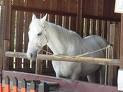
White horse, hakuba 白馬 sacred horse at Shinto shrines
quote
As in all the oldest nations, we find in Japan, as its most ancient religion — Sun-worship. Nor are the Elements forgotten, as those are the abodes of all the "minor gods or spirits" — namely, the Powers or Forces of Nature. The Sun still receives deific honours; and its emblem has fully survived in the Sinto temples, called Maya, [Divine residence. Hence the name of the ecclesiastical metropolis Myako, the abode of the Spiritual Emperor] where no idols or images are to be found, save a bright mirror in the shape of a disc, before which are placed high metallic poles, with long and broad slips of paper attached to them, and mysterious inscriptions on these, traced in the Nai-den style, that peculiar sacerdotal written language used only for religious and mystical subjects.
Strange to think, the Japanese practise in reference to Sun-worship that curious ceremony so well known in India under the name of the aswamedha, or sacrifice of the horse. Anciently the horse was considered by every nation an emblem of the primeval and universal manifested being, who, when identified with the Sun, had the horse given him as his attendant.
"The horses of the Sun" are famous, and were deified in all the old religious systems, even in the youngest of the latter — the Mosaic, or Jewish creed. [And he (Josiah) took away the horses that the Kings of Judah had given to the Sun, at the entering of the House of the Lord. (2 Kings, xxiii. II)]
Every Sun-God has a horse (always white) associated with him. Sosiosh, born of a virgin, is expected to appear at the end of the days upon a white horse as Redeemer, says the book Bun Dehesh. Vishnu, or the "Kalanki Avatar", is to come upon a white horse; and St. John, in the Revelation (xix., 11, 14), sees the heavens opened and the "Faithful and True", or the coming Christian Messiah, seated on a white horse; and the "armies which were in heaven followed him upon white horses". The white horse is the horse of the Sun; and Mithra, the old Medo-Arian Sun-God, reappears everywhere. [ “The Manicheans held that the Sun, who is Mithra, is Christ himself,” says St. Augustine (cap 8) who had belonged to that sect]
For the Sun is the fiery source of Spirit-power or Spirit of LIFE, while the chariot typifies the body, and the horse its animating principle. And thus in Japan Ten-Zio-Dai-Zen, "he who darts out his rays" is presented with its emblem, the horse, at its Temple on certain festive days. A number of sacred horses in pictures and horses cut out of paper with sacred inscriptions on them are hung on the walls.
source : www.theosophical.ca

At Saijo Inari Shrine, Okayama pref.
Photo Gabi Greve 2008
. hakuba 白馬と伝説 Legends about a white horse .
:::::::::::::::::::::::::::::::::::::::::::::::::::::::::::::::::::::::::::::::::::::::::::::::::::::

At Kibune Shrine, Kyoto
貴船神社の馬
The ancient Japanese religion was heavily concerned with water, many of the oldest shrines were placed at important water sources, and this is the case with Kibune. Enshrined here are the God Kuraokami no kami and his wife the Goddess Mizuhonone no kami, both considered water gods. Once the capital was moved to Kyoto the Emperor would visit here for ceremonies connected with rain.
If rainfall was needed,
a black horse would be offered to the shrine,
if dry weather was needed, a white horse.
source : japanvisitor.blogspot.com
:::::::::::::::::::::::::::::::::::::::::::::::::::::::::::::::::::::::::::::::::::::::::::::::::::::
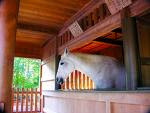
jinme, shinme, shinba 神馬,
kamikoma 神駒(かみこま), 御神馬
horses offered to a shrine as vehicles for the gods
The White Horse at Miyajima 宮島白馬
Horse of the Gods at Miyajima 宮島の神馬
One of the seven wonders of Miyajima.
Horses offered to this shrine will turn to a white color within four or five years of living here.
It is sayed that Taira no Kiyomori, who had the shrine build, came visiting often because there was a beautiful woman with white skin living on the island.

© PHOTO : www.miyajima1.com
. Itsukushima Shrine and Kigo 厳島神社
:::::::::::::::::::::::::::::::::::::::::::::::::::::::::::::::::::::::::::::::::::::::::::::::::::::
At Shrine Oasahiko Jinja in Awaji
Oasahiko no Okami 大麻比古の大神

Photo Gabi Greve, 2007
Oasahiko Shrine - Introduction
:::::::::::::::::::::::::::::::::::::::::::::::::::::::::::::::::::::::::::::::::::::::::::::::::::::

White horse ema votive tablet of Hakone shrine
箱根神社
:::::::::::::::::::::::::::::::::::::::::::::::::::::::::::::::::::::::::::::::::::::::::::::::::::::
Memyo Bosatsu 馬鳴菩薩(めみょうぼさつ)
"Neighing Horse Bosatsu"
"Neighing horse deity", menari myojin 馬鳴明神
馬に乗る女神の蚕玉神
Silkworm Goddess on a Horse
The Woman Who Married a Horse
Japanese SILK Deities
:::::::::::::::::::::::::::::::::::::::::::::::::::::::::::::::::::::::::::::::::::::::::::::::::::::
batoo jizoo 馬頭地蔵 "horse-headed Jizo Bosatsu"
still looking for the details.
謎の「馬頭地蔵(ばとうじぞう)
- reference - xxx
:::::::::::::::::::::::::::::::::::::::::::::::::::::::::::::::::::::::::::::::::::::::::::::::::::::
Horse-headed Fudo Myo-O. Bato Fudo Myo-O
不動明王馬頭独鈷杵 Batoo Fudoo Myoo Oo
On a Nepalese Vajra

- reference -
:::::::::::::::::::::::::::::::::::::::::::::::::::::::::::::::::::::::::::::::::::::::::::::::::::::
The Horse in Japanese Haiku
Ema 絵馬 Votive Plaques, Votive Tablets, Prayer Boards
Lit. "Paintings of Horses"
:::::::::::::::::::::::::::::::::::::::::::::::::::::::::::::::::::::::::::::::::::::::::::::::::::::
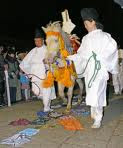
. hakubasai, hakuba sai 白馬祭(はくばさい)
Festival of the White Horse
oumesai, o ume sai 【白馬祭(おうめさい)】
ao-uma no matsuri 青馬祭 (あおうまのまつり)
aouma no sechi-e 青馬(あおうま)の節会(せちえ)
. . . . also called
hakuba sechi-e 白馬節会
nanuka no sechi-e 七日の節会 (なぬかのせちえ)
Seasonal Feast on the seventh day (of the New Year)
kigo for the New Year
If you see a white horse during the New Year celebrations, you will live a long life and ward off evil for the coming year and stay healthy. Therefore shrines with a white horse make a parade for all to see the animal. Some parades are quite famous and reach back to the Kamakura period. In Kashima, they parade seven white horses. If you pick up a small stone where the horses walked or have your hankerchief trodden on, this will bring your love to fulfillment.
On this day, white sweet ricewine (amazake) and porridge of seven herbs is also served.
There is a poem by Otomo Yakamochi 大伴家持 in the ManyoShu poetry collection, dating from 758:
水鳥の鴨の羽の色の青馬を
今日見る人はかぎりなしといふ
The people who viewed the white horse today
- the color of the wings of a white duck -
Will enjoy long life, it is said.
Tr. Taro Sakamoto
. hakuba 白馬と伝説 Legends about a white horse .
:::::::::::::::::::::::::::::::::::::::::::::::::::::::::::::::::::::::::::::::::::::::::::::::::::::
The famous Painter Higashiyama Kai has a serious of "white horse" paintings,
"White Horse in a Forest" is the most famous.
. . . CLICK here for Photos !
東山 魁夷【白馬】
:::::::::::::::::::::::::::::::::::::::::::::::::::::::::::::::::::::::::::::::::::::::::::::::::::::
. Kunimuke matsuri 平国祭(くにむけまつり)Kunimuke Festival
with a sacred horse procession
. "Horse-headed Kannon of Kamioka"
上岡の馬頭観音 .
with a famous market for ema votive tablets of horses
Saitama, Kanto
. Koma 駒 horse folk toys from Japan
[ . BACK to WORLDKIGO . TOP . ]
[ . BACK to DARUMA MUSEUM TOP . ]
- #batokannon #horsehead -
:::::::::::::::::::::::::::::::::::::::::::::::::::::::::::::::::::::::::::::::::::::::::::::::::::::


 Posts
Posts


10 comments:
Smell so much !
This let me back to my native
town where once househead Kan-non
has stood.
Thamk you, Gabi san.
sakuo.
PS,
Thank you, Gabi san for your interesting information about O-take san , refering to Issa haiku.
It is very helpfull for me, and Otake-san become more familiar.
Warmly sakuo.
Hi Sakuo and all,
here is a little more about O-Take Nyorai, I am still working on it.
http://fudosama.blogspot.com/2005/05/o-take-nyorai.html
Quite intersting subject, Sakuo san! Thank you!
Gabi
bow to Batou kannnon sama deeply
The Kannon guard for horses.
horses were very important animal for labor and traffic long time
ago in Japan.
People made the Kannnon to graduate horses
My fathere is next me now on my office at Tokyo . He told me looking your picture.
The batou kannnon face of yours
very nice
living
etuko
http://groups.yahoo.com/group/cherrypoetryclub/message/23273
love it Gabi...brings back some memories when my daughter wanted a horse I told her she had to kiss a horse turd (excuse please) and wish.... she did ... she got her horse... and to this day I love the smell horses only eat good stuff...
loved your saki haiku...I make saki lilikoi saki..
S.
horse-dung
on the cobble stones
old Bruges
the marchers pelt
horse-dung at the police
peace on earth
GEERT
Discussion about a white horse haiku by
Patrick Sweeney
And there are literally "White Horse Mountains" in China (Yunnan and Zhejiang provinces), America (California), in Japan (Nagano Prefecture), and there may be others. We know Patrick Sweeney lives in Japan.
THF The Haiku Foundation
Komagatachoo 駒形町 Komagata district Tokyo
Komagata doo 駒形堂 Komagata Do Hall
with a statue of Bato Kannon
.
https://edoflourishing.blogspot.jp/2018/03/komagata-district.html
.
Ekoin Kannon, Ekō-in 回向院観音 - Ryogoku
諸宗山 Shoshuzan, 無縁寺 Muen-Ji
with a statue of Bato Kannon
.
https://gokurakuparadies.blogspot.com/2020/09/ekoin-kannon-ryogoku.html
.
Legend from Aichi, Temple Daichi-In 大智院
.
馬頭観音(お前立) Bato Kannon with a Horse Head (o-Maedachi)
.
https://gokurakuparadies.blogspot.com/2021/04/daichiin-fudo-kasuya.html
.
Post a Comment