rough times leaving their scars - old camphor tree  schwere Zeiten hinterlassen Spuren - alter Kampferbaum oooooooooooooooooooooooooooooooooooooo a holy rope marks the deity - a thousand living years  ein heiliges Seil schmueckt die Gottheit - tausend Jahre Leben oooooooooooooooooooooooooooooooooooooo 楠木や 千年万年の 傷の跡 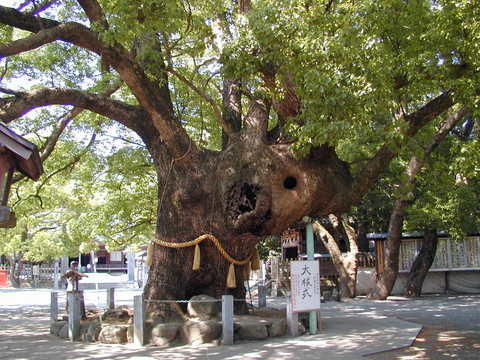 大麻比古神社,大楠木 Oasahiko Shrine, Kusunoki |
:::::::::::::::::::::::::::::::::::::::::::::::::::::::::::::::::::::::::::::::::::::::::::::::::::::
My full story of this shirne is here:
Daruma Doll Museum : Ooasahiko Shrine Naruto
More about the sacred rope to God's ear,
the Shimenawa 注連縄
Shikoku Summer 2005 Our own Haiku Pilgrimage May 2005
:::::::::::::::::::::::::::::::::::::::::::::::::::::::::::::::::::::::::::::::::::::::::::::::::::::
Kusunoki Masatsura 楠木正行
(1326 – February 4, 1348),
along with his father Masashige and brother Masanori, was a supporter of the Southern Imperial Court during Japan's Nanbokucho Wars.
Masatsura was one of the primary military leaders who revived the Southern Court in the 1340s. The Court had had little to no resources for three years; the strategy was too focused on defending their base at Yoshino, and not on gaining allies, land, or income. The Kusunoki family, and Masatsura in particular, fought to gain power and support for the Emperor.
In 1347, Masatsura led an attack on bakufu (shogunate) sympathizers in Kii Province and ended up attracting supporters from Kii, as well as Izumi and Settsu Provinces. When the Shogun's Northern Court sent Hosokawa Akiuji to stop him, Masatsura met Hosokawa and defeated him in the battle of Sakainoura.
After several more campaigns against the bakufu, Masatsura was killed in the Battle of Shijō Nawate, in February 1348 at the age of 22.
Before he died, he composed a death poem:
帰へらじと 兼ねて思へば 梓弓
亡き数に入る 名をぞとどむる
kaeraji to kanete omoeba azusayumi
nakikazu ni iru na o zotodomuru
I have a feeling
I will not be returning,
so among the names
of those who died by the bow
I inscribe my own.
© More in the WIKIPEDIA !
I could not return, I presume,
So I will keep my name
Among those who are dead with bows.
source : Mitch Campbell 2009
.................................................................................

The warrior Kusunoki Masashige 楠木正成 (died 1337)
had a small statue of Marishiten in the decoration of his helmet. Others say so did Yamamoto Kansuke 山本勘助, Maeda Toshiie 前田利家and other samurai of old. Others used the small figure of a wild boar and the swastika.
. MARISHITEN 摩利支天
. Kanshinji 観心寺 Kanshin-Ji .
This temple was a place of study for the young Kusunoki Masashige ...
. Aichi, 旭土人形 clay dolls from Asahi .

made by 美濃部泰作 Minobu Daisaku
..........................................................................................
撫子にかかる涙や楠の露
nadeshiko ni kakaru namida ya kusu no tsuyu
tears are falling
on this little pink -
dew from the camphor tree
Tr. Gabi Greve
Written about 貞亨元年, Matsuo Basho age 41 or later.
The pinks are below the camphor tree.
KUSU refers to the warrior Kusunoki Masashige 楠正成 (1294 - 1336).

The scene is "Separation in Sakurai"
(Sakurai no wakare 桜井の別れ), when Masashige has to send his son and heir Kusunoki Masatsura 楠木正行 (1326 - 1348) back to his headquarters in Kawachi Province. His tears fall on his sleeve, since this is a final farewell.
Basho represents the father as the tree,
the boy as the nadeshiko below the big tree.
MORE - Hokku about tears by
. Matsuo Basho 松尾芭蕉 - Archives of the WKD .
:::::::::::::::::::::::::::::::::::::::::::::::::::::::::::::::::::::::::::::::::::::::::::::::::::::::
observance kigo for early summer
Nankoosai 楠公祭 (なんこうさい) Nanko Festival
Festival for Lord Kusunoki
Nankoo matsuri (なんこうまつり)
May 25
(from May 24 to May 26)

Main shrine festival in honor of Kusunoki Masashige,
at Minatogawa Jinja in Kobe. 湊川神社 神戸
Masahige is believed to have died here.
More than 1000 people take part in the parade. Their costumes and equipment is all re-made like in the Kamakura period.
16 samurai as members of the Kusunoki clan take part riding on horseback.
. . . . .

Homepage of Minatogawa Shrine
with a video of the festival
http://www.minatogawajinja.or.jp/festival/
http://www.minatogawajinja.or.jp/
. Saijiki for Japanese Festivals
:::::::::::::::::::::::::::::::::::::::::::::::::::::::::::::::::::::::::::::::::::::::::::::::::::::
. Kusunoki Jinja 楠木神社 .
andl the tanuki badger legend
Oldest camphor tree at
. Daizenji Tamadare no Miya 大善寺玉垂宮, .
Kurume city, Kyushu
:::::::::::::::::::::::::::::::::::::::::::::::::::::::::::::::::::::::::::::::::::::::::::::::::::::
. Azuma no Mori renri no azusa 吾嬬の森連理の梓
The Conjoined Camphor Trees by the Azuma-no mori Shrine .
Hiroshige print
Today there is the Shrine 吾嬬神社 Azuma Jinja where 日本武尊 Yamato Takeru and his wife, 弟橘姫 Princess Ototachibana Hime, are venerated.
Former 吾嬬権現社 Azuma Gongen no Yashiro
In the compound is a huge kusunoki 樟 camphor tree with bifurcated stem.
Yamato Takeru went to the the North of Japan. He lost his wife Oto Tachibana-Hime during a storm when she sacrificed herself to soothe the anger of the sea god.
The shrine was built there and two 供養箸 ritual chopsticks placed in the ground.
Legend knows that these two chopsticks grew into the camphor tree.
:::::::::::::::::::::::::::::::::::::::::::::::::::::::::::::::::::::::::::::::::::::::::::::::::::::
........................... plant KIGO
fallen leaves of the camphor tree,
kusu ochiba 楠落葉
this is a kigo for early summer, belonging to the group of
tokiwa ki no ochiba (tokiwagi ochiba)
ときはぎのおちば 常磐木落葉.
[ . BACK to DARUMA MUSEUM TOP . ]
[ . BACK to WORLDKIGO . TOP . ]
- #kusunoki #masashige -
:::::::::::::::::::::::::::::::::::::::::::::::::::::::::::::::::::::::::::::::::::::::::::::::::::::


 Posts
Posts


17 comments:
wow gaby san
some old the tree a dinosaur... very nice
aloha
s.
Dear Gabi san
I really got a fine feeling from your haiku. I especially like the
last one. It brought to mind the many types of ropes at the many
temples and shrines in Japan.
a long rope to God's ear -- autumn rain
ai... chibi
Oh Gabi,
I love old trees!
And your top camphor tree is really
something...I see a face!
And I really enjoyed learning about
the holy rope, and the purifying...
:~)
L.
Gabi,
I thoroughly enjoyed these haiku and photos. I'm still going through your pilgrimage photos and I'm so excited that you took all of them to share with us :))) You have beautiful photos of some majestic trees!
Seeing the holy rope around the trees reminds me of the yellow ribbons that people tie around the trees here in remembrance of those who are serving in the war. But the holy rope is to signify respect given to a tree that has endured so many years.
Thank you!
B.W.
...................................
楠木や 千年万年の 傷の跡
露の世なれば 人みないとし
GabiさんのHPで遍路俳句を見せて頂きましたよ~♪
日本文化を良く理解されているのに いつも感心します。
わたしのほうが 教えてもらってばかりで助かっています。
ありがとうございました~(^-^ )♪
啓さん
..................................
Gabiさま
お彼岸は暦の上では今日です。
樹齢三千年の楠木。注連縄を巻かれて神々しい。
歌寿人
...................................
楠木や 千年万年の 傷の跡
荒ぶる神に 耐えて結う縄
厳か(ogosoka)です! 神々しい(koogooshii)です!
ステキ!(suteki)←(これは必要なかったネー^-^;)
をのひ
...................................
BLOG句会のみなさま、ありがとう!!!
http://blog.livedoor.jp/senior21/archives/50056943.html?1127551218
ガビ
。。。。。。。。。。。。。。。。。。。。。。。。。。。。。。。。。。。。。。。。。。
Hi Gabi--
Surfing through your huge and very useful blog, I find this old post. Let's refresh it with a new comment!
I have 3 camphor trees in my yard; only 1 hundred years old, they are youngsters compared to this venerable treasure. Still, they lend a certain majesty to my garden. LOOK HERE
camphor tree
one hundred years old
flush with blossom
--Billie Dee, USA
kiku makura
it looks like a huge wound... very telling! thank you, Gabi-san.
C.
楠かほる護国神社に詣づらく
kuzu kahoru Gokoku jinja no moodezuraku
fragrance of camphor
the Gokoku shrine is difficult
to visit
Takazawa Ryooichi 高澤良一 Takazawa Ryoichi
MORE
http://japanshrinestemples.blogspot.jp/2013/04/gokoku-jinja.html
秋ふるや楠八畳の金閣寺
aki furu ya kusu hachijoo no Kinkakuji
autumn is passing -
the camphor board of eight tatami-mat size
at temple Kinkaku-Ji
. Yosa Buson 与謝蕪村 in Edo .
. Myoken 妙見菩薩 Myoken Bosatsu - 妙見大菩薩 Myoken Daibosatsu .
In the year 1164 a retainer of Minamoto no Yoshitomo named 大久保左馬之祐王家 Okubo went to Mount Mitoku san to pray for the country. On the way he met a white fox, messenger of Myoken San 妙見山 and helped him in distress. At night Myoken Daibosatsu appeared in his dream. He told Okubo that there was a holy spot at the roots of the old camphor tree 老楠. Myoken would pass this on to Okubo if he helped to save people with it.
When Okubo looked the next day, he found the well of a hot spring . . . that was the beginning of Misasa Onsen.
.
the biggest Japanese tree is located here:
“Kamo Town” of Kagoshima Prefecture.
The camphor tree is about 1,500 years.
Kamo Hachiman Shrine
http://kagoshimalove.com/kamou-big-tree?lang=en
Legends to explore
http://omamorifromjapan.blogspot.jp/2015/05/legends-about-trees.html
Ehime 愛媛県 ......................................
At the 老樟 old camphor tree of the 蕨岡 Warabioka family there was a divine light for seven days and seven nights. They called it 熊の権現の神火 the divine light of Kumano Gongen and venerated it at
Mount 篠山 Sasayama (1065 m ).
Years later the Tengu who lived at Sasayama came to live in this tree and played his tricks on the members of the Family. So one day the head of the home shot at him and the Tengu lost one of his wings. To get it back he had to promise never to play tricks around here any more. And to this day, the Tengu protects the Warabioka family.
http://heianperiodjapan.blogspot.jp/2016/09/shinka-divine-fire-legends.html
.
老樟 old camphor / 樟 18 to explore / 楠木 2 / 楠 71 / お楠という嫁
nichibun has many more
.
Legend from Kochi
oigesama お神母様 O-Ige Sama
This is a female deity to watch over the water for the rice fields. Her sacred tree, a kusunoki 楠 camphor tree had been a disturbance for the fields and someone cut branches off it.
His home burned down in a huge fire the same night.
The tree is also sacred to Yamanokami and if someone cuts it down in the shrine compound, there will be great disaster and illness in the whole hamlet.
.
https://japanshrinestemples.blogspot.com/2017/08/yama-no-kami-regional-16-kochi.html
.
Legend from Mukogawa 武庫川 River Mukogawa / Hyogo 兵庫県
rooshoo 老樟 the old camphor tree
At the bank of the river 武庫川 Mukogawa there is an old camphor tree with two main trunks.
If someone cuts it down, there will be a large fire and the man will be cursed.
During some repairs to the riverside the tree was cut down. The man who did it broke his nokogiri 鋸 saw and he developed a high fever.
.
https://edoflourishing.blogspot.com/2019/09/sanyodo-saigoku-kaido-highway.html
.
Tokyo, Hongo Yumicho / Yumi machi 本郷弓町 Hongo Yumi district "Arrow district"
This area is in the kimon 鬼門 Northern Demon Gate direction with respect to Edo castle and in former times 御弓組与力同心 officials with bows and arrows lived there.
本郷弓町のクス the Big Camphor Tree from Hongo Yumi
本郷のクスノキ Hongo no Kusu no Ki / 楠亭の大クス / 弓町の大クス
.
https://edoflourishing.blogspot.com/2018/10/hongo-kikuzaka-kikusaka-district-bunkyo.html
.
Legend from Shizuoka 静岡市
.
At the camphor tree at 法明寺 the temple Homyo-Ji there was 怪光 Kaiko – a mysterious light
and the Emperor became ill.
On the request of a diviner, Gyoki Bosatsu was called.
He carved seven statues of 観音菩薩 Kannon Bosatsu from seven trees
and placed them in a sanctuary.
The Emperor recovered soon after.
.
https://japanshrinestemples.blogspot.com/2022/01/kaiko-mysterious-light.html
.
Legend from Chiba, 臼井町 Usui town
.
When 八幡宮 the Shrine Hachimangu was founded in Usui,
the local lord 臼井太郎興胤 Usui Taro Okitane (? - 1313, age 25) placed his walking stick in the ground.
If the staff would stand and grow, this would be the show of shinrei 神霊 a divine spirit.
The staff began to grow and became 樟の神木 the divine Kusunoki camphor tree.
.
https://japanshrinestemples.blogspot.com/2020/03/shinrei-spirit-legends.html
.
Post a Comment